
















Can Americans Actually Get a Mortgage in Dubai? The Rules for Non-Residents
Checked Oct 27, 2026 · Official sources
Short answer: Yes, UAE Central Bank rules allow lending to expatriates, and each licensed lender sets its own terms for a non-resident American. UAE Central Bank rules set the ceilings: up to 80% of a first home priced up to US$1,361,470 (AED 5,000,000) for expatriates, 70% above that, 60% for a second home, and 50% for any off-plan home. Each licensed lender decides whether, and on what terms, it lends to someone who lives in the US.
Of the 107,450 apartments and villas sold in Dubai between January 1 and October 15, 2026, 81,196 were sold off-plan, before the building was finished. That is 75.6% of all home sales in the period. It is a striking share on its own, but it matters for a quieter reason: under UAE Central Bank rules, no bank may lend more than half the value of an off-plan home, whoever the buyer is.
So the first honest answer to the question many Americans type into a search bar, "can I get a mortgage in Dubai?", is that for most of what Dubai actually sells, a loan can cover at most half. This article sets out what the UAE's lending rules allow a non-resident to borrow, which decisions are left to each lender, what a mortgage adds to the cost of buying, and what the public sales record can and cannot tell you about how Dubai buyers pay.
The rules point in one direction. The rules permit lending to expatriates and set the maximum each loan can reach. Within that range, the offer rests on a lender's own assessment about a borrower whose income, credit history and address are all in another country.
Based on Dubai Land Department open data via Data.Dubai, 1 Jan – 15 Oct 2026.
Who sets the rules for a Dubai mortgage
Mortgage lending across the UAE is governed by the UAE Central Bank, not by Dubai's property authorities. Its Mortgage Regulations, published in the Central Bank Rulebook, set the maximum share of a property's value a bank may lend, the longest permitted term and the affordability tests a borrower must pass.
The Dubai Land Department's role comes later. Once a loan is agreed, the mortgage is registered against the property in the land register, and that registration carries its own fee.
How much a UAE bank may lend an expatriate
The Central Bank's loan-to-value limits tighten as a purchase moves away from a first, finished home:
- First home priced up to US$1,361,470 (AED 5,000,000): up to 80%.
- First home priced above US$1,361,470 (AED 5,000,000): up to 70%.
- Second or investment home: up to 60%.
- Off-plan home, for any buyer: up to 50%.
Under the Central Bank's published limits, a ready first home priced at US$544,588 (AED 2,000,000) could carry a loan of up to US$435,670 (AED 1,600,000), leaving at least US$108,918 (AED 400,000) to come from the buyer before any fees. On an off-plan home at the same price, the most a lender could advance is US$272,294 (AED 1,000,000).
The other limits that shape a loan
Loan-to-value is only one of several ceilings. The same regulations set a maximum term of 25 years. They cap a borrower's total debt payments at 50% of gross salary plus regular income. They require lenders to test affordability at a rate 2 to 4 percentage points above the current one. And they limit an expatriate's loan to 7 times annual income.
None of these limits mentions where a borrower lives. They describe what a bank is permitted to do, not what it must do.
What "non-resident" changes
The Central Bank rules distinguish UAE nationals from expatriates. They do not, in the passage cited above, guarantee credit to a foreigner who lives abroad. Whether a bank lends to a non-resident at all, and on what terms, is a commercial decision taken within those rules.
That decision usually turns on questions a lender has to answer about a borrower based abroad:
- How it will verify income earned in the US, and in what currency.
- Whether it accepts a US credit report, or any foreign credit history.
- What share of the price it is willing to advance, which may be lower than the regulatory maximum.
- What rate, fees, insurance and valuation costs it applies.
Because each lender answers these differently, the only reliable statement of what an individual American can borrow is a written offer from a lender licensed by the UAE Central Bank. The Central Bank publishes a register of licensed institutions that can be checked before any application. Moonlanding does not name or compare lenders.
The currency question
For a borrower paid in dollars, currency is simpler than it first appears. The UAE dirham has been pegged to the US dollar, and the Central Bank shows a rate of AED 3.6725 per dollar, describing its monetary framework as maintaining that peg. Interest rates, however, are set by each lender and can change over the life of a loan.
What a mortgage adds to the cost of buying
Borrowing brings costs that a cash purchase does not. The Dubai Land Department charges 0.25% of the loan amount to register an ordinary mortgage, plus a fee for the updated title deed. On a loan of US$435,670 (AED 1,600,000), the registration fee alone would be US$1,089 (AED 4,000).
The same DLD page lists a legal power of attorney among the documents accepted when a representative registers the mortgage on the buyer's behalf, which matters for anyone completing from the US. Lenders' own arrangement, valuation and insurance charges come on top and vary by institution.
The mortgage costs sit alongside the purchase costs every buyer pays, such as the DLD transfer fee and trustee charges, which are set out in our guide to the cost of buying in Dubai.
What the public record does not show
It would be useful to know how many Dubai buyers borrow and how many pay cash. The public sales record cannot say. DLD's open transactions data records the price, date, area, property type and whether a sale was ready or off-plan, but not how the purchase was paid for. Any claim about the share of mortgage-financed purchases should be read with that limit in mind.
What the record does show is the shape of the market a borrower enters. In the period above, 26,254 sales were of ready homes and 81,196 were off-plan. For the larger group, the regulatory ceiling on borrowing is 50%, and buyers' payments go into the project's escrow account under Dubai's 2007 escrow law rather than directly to the developer.
Based on Dubai Land Department open data via Data.Dubai, 1 Jan – 15 Oct 2026.
Reading the rules together
Taken together, the rules describe a system that is open to foreign borrowers, with clear published ceilings. A non-resident American can, within the regulations, borrow up to 80% of a first ready home. Each lender sets its own offer within those ceilings, off-plan loans can cover up to 50%, and the income and debt tests apply to a borrower whose finances are documented in another country.
None of this says whether borrowing is wise for any particular buyer. That depends on circumstances this article cannot see. What the facts do establish is the range within which that decision is made.
For readers who want the full sequence of costs, checks and registrations in one place, the Buyers Full Brief (169 pages, US$399 (AED 1,465)) sets out the purchase process step by step from official sources.
Frequently asked questions
Can a US citizen who lives in the US get a Dubai mortgage?
The UAE Central Bank rules allow lending to expatriates, but each licensed lender decides whether it lends to non-residents and on what terms. A written offer is the only firm answer.
What is the maximum loan on an off-plan home?
50% of the value, for any buyer, under the UAE Central Bank's mortgage regulations.
What is the longest mortgage term allowed?
25 years, under the same regulations.
Does the dirham's exchange rate move against the dollar?
The Central Bank shows AED 3.6725 per US dollar and describes its framework as maintaining the peg. Interest rates are separate and set by each lender.
How much does it cost to register a mortgage?
DLD charges 0.25% of the mortgage value for an ordinary mortgage, plus a title deed fee.
Does DLD data show how many buyers use a mortgage?
No. The open sales data does not record how a purchase was paid for.
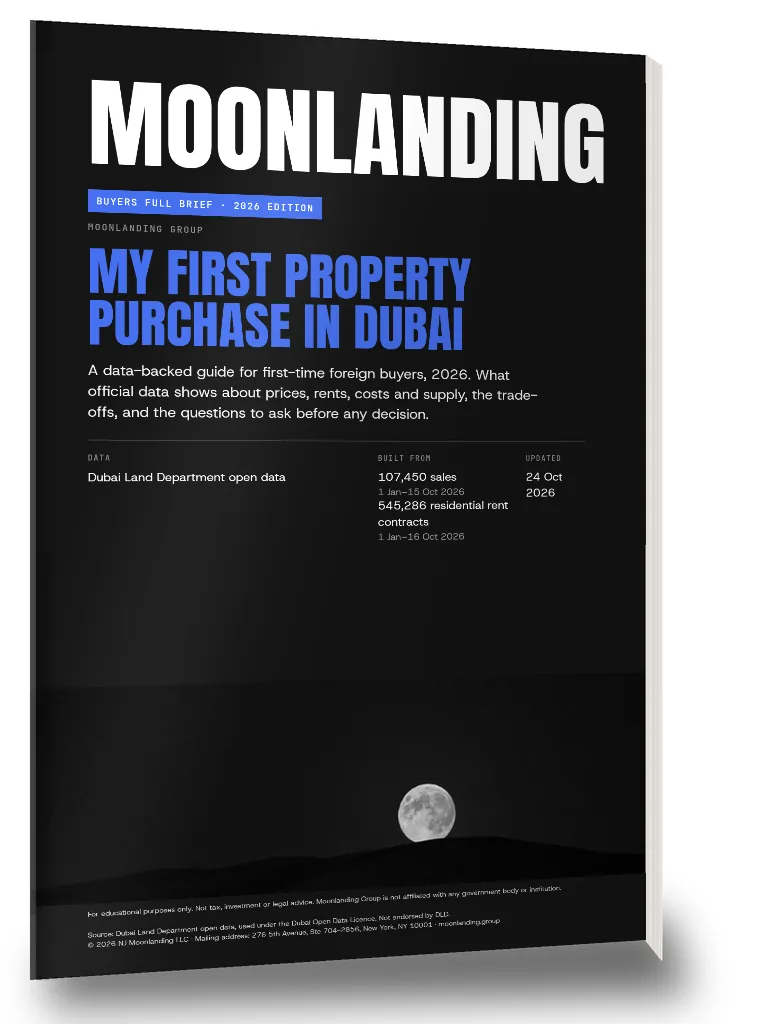
Buyers Full Brief: buying in Dubai, step by step
Built on official Dubai government data (Dubai Land Department).
$399 (AED 1,465)
See the Buyers Full BriefSources
- UAE Central Bank Rulebook, Mortgage Regulations, Art. 3, checked Oct 27, 2026
- UAE Central Bank, Licensing – CBUAE Register, checked Oct 23, 2026
- UAE Central Bank, Exchange rates; Monetary policy framework, checked Oct 23, 2026
- Dubai Land Department, Mortgage Registration, checked Oct 27, 2026
- Dubai Legislation Portal, Law No. 8 of 2007 on escrow accounts (browse legislation), checked Oct 23, 2026
- Dubai Land Department open data, transactions file of Oct 16, 2026, period 1 Jan – 15 Oct 2026, checked Oct 24, 2026
- Source: Dubai Land Department open data via Data.Dubai, used under the Data.Dubai Open Data Licence. Our analysis is independent and not endorsed by the Dubai Land Department or the Government of Dubai.
NJ Moonlanding LLC (Moonlanding Group) publishes independent research for information only. It is not legal, financial or tax advice, nor brokerage, and we take no commission from brokers or developers.
Figures are our own analysis of Dubai Land Department open data and may differ from other published figures. Source data is provided as is and can be revised after we publish. To the extent the law allows, NJ Moonlanding LLC is not liable for decisions made on this information. Check every decision with a licensed professional.
Source: Dubai Land Department open data via Data.Dubai, used under the Data.Dubai Open Data Licence. Our analysis is independent and not endorsed by the Dubai Land Department or the Government of Dubai.
Related guides
- Can Americans own property in Dubai? What the law says
- Buying in Dubai from the US: how it works
- What does it cost to buy in Dubai? DLD fees in USD
- Buying in Dubai: checks to make before you pay
- Is the Dubai property market up or down?
- How big are Dubai apartments?
- Dubai home sales by type
- Can a Dubai home get you a golden visa? What official sources say
- What is selling in JVC? Sales, prices and home sizes
Buyers Full Brief

Read this before you buy in Dubai.
Not knowing can cost you more later. The Buyers Full Brief is a book on costs, checks and rules.
Read next

Buying in Dubai: Checks to Make Before You Pay
The simplest safeguard: pay only into the project's escrow account, never a personal one.